Cycling workout app
Structured cycling workouts give a session a purpose and a sequence. The useful choice is not simply the hardest workout available, but the effort that fits your goal, recent riding and recovery.
Available for iPhone
Know what the session is asking for
Duration tells only part of the story. Look at the length of each effort, the recovery between efforts and how often the pattern repeats. A workout with short bursts and generous recovery asks something different from a long continuous effort, even when the total riding time is similar.
Training zones are ways of organising intensity, and their exact boundaries vary between systems. Treat the names below as qualitative guidance. If a workout uses targets based on your threshold, use an appropriate, current reference rather than copying another rider’s numbers.
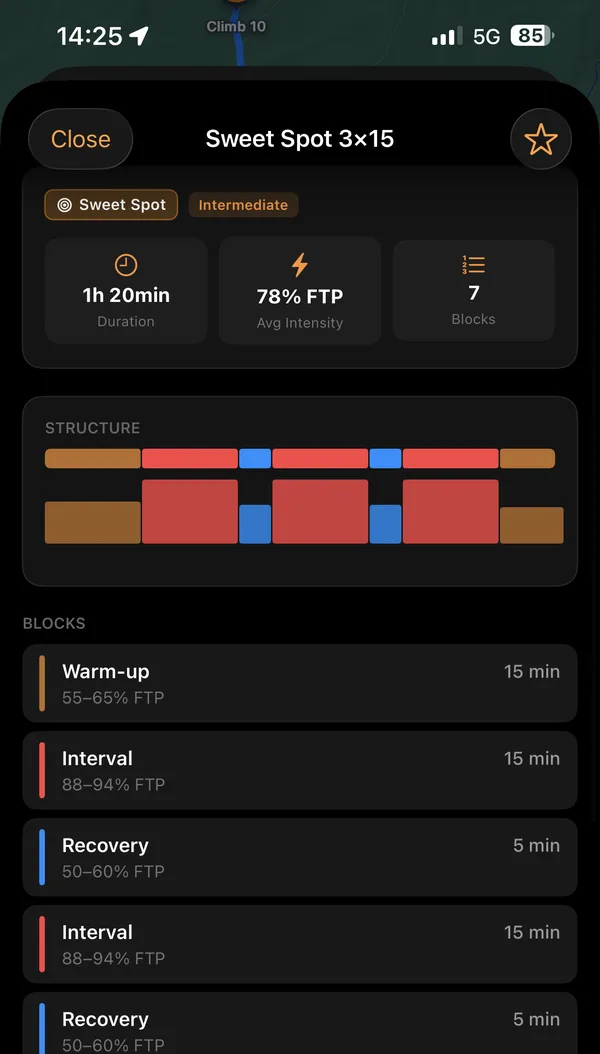
Do not confuse average intensity with the effort in every block. Warm-up and recovery can lower a session’s average while its hardest intervals remain demanding. Read the sequence before deciding whether the workout fits today.
What the different workout types are for
- Endurance: steady, relatively comfortable riding used to develop the ability to sustain aerobic effort. It is the sort of work where conversation is generally possible, and where keeping the pace controlled matters more than chasing each hill.
- Tempo: a firmer, sustained effort than easy endurance riding, usually making conversation less relaxed. It is used to practise holding a stronger pace, but a long tempo block still creates fatigue and needs a place in the wider week.
- Sweet spot: work around the upper end of tempo and lower end of threshold. It is commonly used for sustained aerobic work between easy riding and harder threshold efforts; the name does not mean it is effortless or the right choice every day.
- Threshold: demanding, sustained work near your functional threshold. It is commonly split into intervals to practise maintaining that effort with recovery between blocks. The target is personal, so another rider’s wattage is not a useful prescription for you.
- VO2max: hard intervals aimed at aerobic capacity, with recovery allowing another effort. These are more intense than steady threshold work and generally leave little room for conversation during the effort. Repetition quality matters more than making the opening interval your fastest.
- Sprints: brief, very high-effort bursts used to practise acceleration and neuromuscular power. They differ from long hard intervals in both duration and purpose. Give them suitable recovery and a place where the effort will not conflict with traffic or other riders.
- Recovery: very easy riding intended to keep the session light between more demanding days. Resist turning it into a test of speed; if the intention is recovery, that intention should govern the pace rather than the average from a previous ride.
Choose by purpose, then read the blocks
In Glood, browse and search the workout library by type and level up to Elite, then open a session to read its average intensity and block-by-block structure. Browse the cycling workout library by type and level to read the full sessions here.
Match the session to the week rather than selecting it in isolation. Consider what you did yesterday and what is planned next. A short workout can still be demanding, and replacing an easy day with intervals changes more than the time you spend on the bike.
For a longer progression, compare cycling plans by level and goal before adding extra hard sessions. Review training load after a recorded ride as part of the recent pattern, alongside the effort you actually felt.
Make custom blocks serve a clear idea
Build and save a custom workout in Glood from warm-up, effort, recovery and cool-down blocks.
Write down the session’s purpose before choosing its blocks. Decide what you want to repeat, how much recovery should separate the efforts and whether the full session fits your available time. Check the total after adding warm-up and cool-down; those parts still occupy time even when they are easier.
Keep an early attempt simple enough to understand while riding. A sequence you can explain to yourself is easier to review afterwards than a long collection of unrelated efforts. Judge it against its purpose, not just whether you finished every block.
Questions before your ride
Is it only for experienced riders?
No—Glood’s workout levels run from Beginner through Elite.
Should every workout be hard?
No, easy endurance and recovery sessions have different purposes from demanding intervals. Choose the session for its place in your week, rather than treating maximum effort as the goal of every ride.
What is the difference between a workout and a training plan?
A workout describes one session; a training plan arranges sessions across days and weeks. The same workout can serve a different role depending on the riding and recovery around it.